
I want to:
- Sign up for email newsletter to get the latest updates
- Read a fact sheet in English or Spanish
- Submit a comment
- Ask a question
Over the last century, salmon runs in the Chehalis Basin have declined dramatically, and floods have become bigger, more frequent, and more dangerous. Scientists warn these trends will worsen as weather patterns become more unpredictable.
For a long time, people have fought over these issues. Now, we’re finally making progress toward a safer, more resilient basin.
The Chehalis Basin Board, a diverse group of representatives from Tribes, local governments, citizens, and state agencies, has brought forth more than 200 projects in aquatic restoration and flood protection on time and on budget, helping every community across the basin. Read more about the range of projects and programs.
Building on this momentum, in 2026, the Chehalis Basin Board is on track to make recommendations on a long-term Chehalis Basin Strategy to protect people and aquatic life for decades to come.
Latest updates (February 2026)
- Throughout 2025, the Office of Chehalis Basin shared information with the Basin community on the long-term options the Chehalis Basin Board is weighing and collected feedback for the Board to consider. To learn more about our outreach activities and the comments we received last year, see the 2025 LTS Outreach Summary and Comment Analysis, delivered to the Board as part of their February 2026 meeting materials. You can also learn more about recent on-the-ground projects and long-term strategy process in OCB’s 2025 Year in Review report.
- Due to unforeseen delays in the technical analysis of the long-term strategy, the Board’s recommendation timeline has moved to late 2026. Throughout 2026, OCB will provide more opportunities to stay engaged and provide feedback on the long-term options for flood protection and aquatic restoration. Look for updates on this webpage, in the monthly newsletter, and via social media posts. In the meantime, the comment form remains open to share thoughts and perspectives on what you’d like the Board to consider as it continues weighing the long-term options.
- On Nov. 20, 2025, the Washington State Department of Ecology released a Revised Draft Environmental Impact Statement on the proposed Chehalis River flow-through dam and airport levee improvements. See the state environmental review page to access the document and learn more about the public comment period open through Feb. 4, 2026. Note that this comment opportunity is specific to the flow-through dam and airport levee DEIS and is separate from the feedback OCB is collecting on the long-term strategy options.


What is the long-term strategy?
The Chehalis Basin Strategy is an action plan for reducing flood damage and restoring aquatic life. In 2026, the Board will extend that plan by making recommendations on long-term actions designed to protect the basin for decades to come.
Why is a long-term strategy necessary?
Larger-scale, longer-term investments are still needed. As long as weather patterns continue to shift and habitat continues be lost or damaged, scientists predict salmon and steelhead will decline to new lows without aggressive protection and restoration. Additionally, 100-year floods could happen as often as once a decade by the end of the century.
A strong long-term strategy is essential for preserving some of the state’s most important industries, vital transportation corridors and abundant salmon runs. What happens in the Chehalis Basin impacts all of Washington and beyond.
What solutions are being considered for the long-term strategy?
The Chehalis Basin Board is considering:
- How much should be invested in aquatic restoration for the next 30+ years?
- Are large-scale structural flood option(s) needed for the upper basin, such as a proposed flood-control dam near Pe Ell, a system of local levees and floodwalls in and around Chehalis and Centralia, or some combination of both?
- What is the best pathway for the Skookumchuck Dam going forward?
The Board will also consider how it can continue to support and expand other local projects, policies, and programs that protect people and aquatic habitats across the basin.
How are these solutions being thought of together?
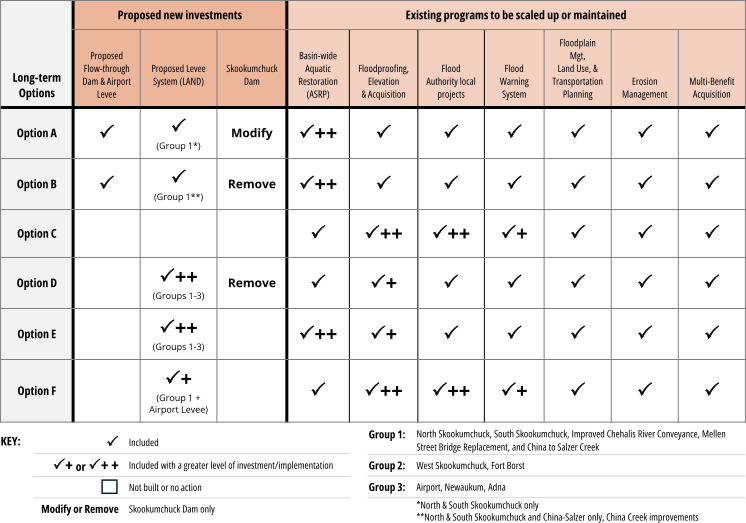
In June 2025, the Board met for an all-day workshop to determine what combinations of projects and investments – or options – they’d like to see studied further. Board members reached consensus on six different long-term strategy options to evaluate. These six options represent a broad range of potential pathways for the future of the basin – from high investments in structural flood damage reduction and aquatic restoration measures, to a focus on non-structural flood protection, and several “middle of the road” options in between. They may change based on what’s learned from a technical evaluation and community input.
To learn more about what was included in the options, see the table below and the Long-Term Strategy Options Fact Sheet. You can also watch the recording of the Board’s June 6 workshop.
Where can I learn more about the individual proposed projects or programs within the options?
To learn more about individual projects or programs within the options, see our fact sheets and webpages on:
- The Long-Term Strategy Options (Fact Sheet)
- The Proposed Flow-through Dam for Flood Control (Fact Sheet/Webpage)
- The Local Action Non-Dam Alternative (LAND) (Fact Sheet/Webpage)
- Pathways for the Skookumchuck Dam (Fact Sheet/Webpage)
- The Aquatic Species Restoration Program (Fact Sheet/Webpage)
- The Chehalis River Basin Flood Authority and local flood projects (Fact Sheet/Webpage)
- The Community Flood Assistance and Resilience Program (Fact Sheet/Webpage)
- Erosion Management Program (Webpage)
How will the Board make its recommendation?
The Board is committed to a science-based, community-informed process.
Now through summer 2026, technical experts are analyzing the costs, benefits, and tradeoffs of these different options, evaluating factors such as how many homes might be protected, how fish populations could be impacted, and what the long-term economic and environmental effects might be. The analysis is broken down into several evaluation categories and will collect qualitative and quantitative data. The evaluation categories are as follows:
- Environment-focused: Salmon and steelhead, aquatic habitats and other aquatic species, and land-based species and habitats
- Economic-focused: Buil infrastructure damages, transportation infrastructure, economic activity, agriculture and timber lands, and commercial fishing
- Social- and cultural-focused: Health and safety, community cohesion, culturally important sites and resources, and recreation
- Additional considerations : Feasibility, implementation costs, effect on vulnerable populations
Input from Chehalis Basin residents, organizations, partners, local governments, and Tribes will also play an important role in the Board’s upcoming decision-making.
How can I learn more and share feedback?
Throughout 2025 and 2026, you will be able to learn more about the long-term options the Board is considering via webinars, online and in-person events, and community events. You will also be able to share comments via a comment form, a survey, and Board listening sessions. Input collected throughout the process will be compiled and considered by the Board along with the results of technical studies during its deliberations in 2026.
Is there something you want the Chehalis Basin Board to consider as it weighs long-term options for aquatic restoration and flood protection? Use this comment form to share your input.
I missed the open houses. Can I see the materials?
Yes, the display boards can be viewed and downloaded via this link.
How can I get the most updated information?
Keep checking this web page for the latest updates. Stay connected by signing up for email newsletters and following us on social media – we are on Facebook and Instagram.
Questions? Contact us as info@officeofchehalisbasin.com.